ECC for Claude Code and Cursor: what an install actually costs
ECC is an MIT-licensed optimization, memory and security layer for Claude Code, Codex and Cursor. It adds skills, hooks and scans, and it adds a maintenance job your studio owns.
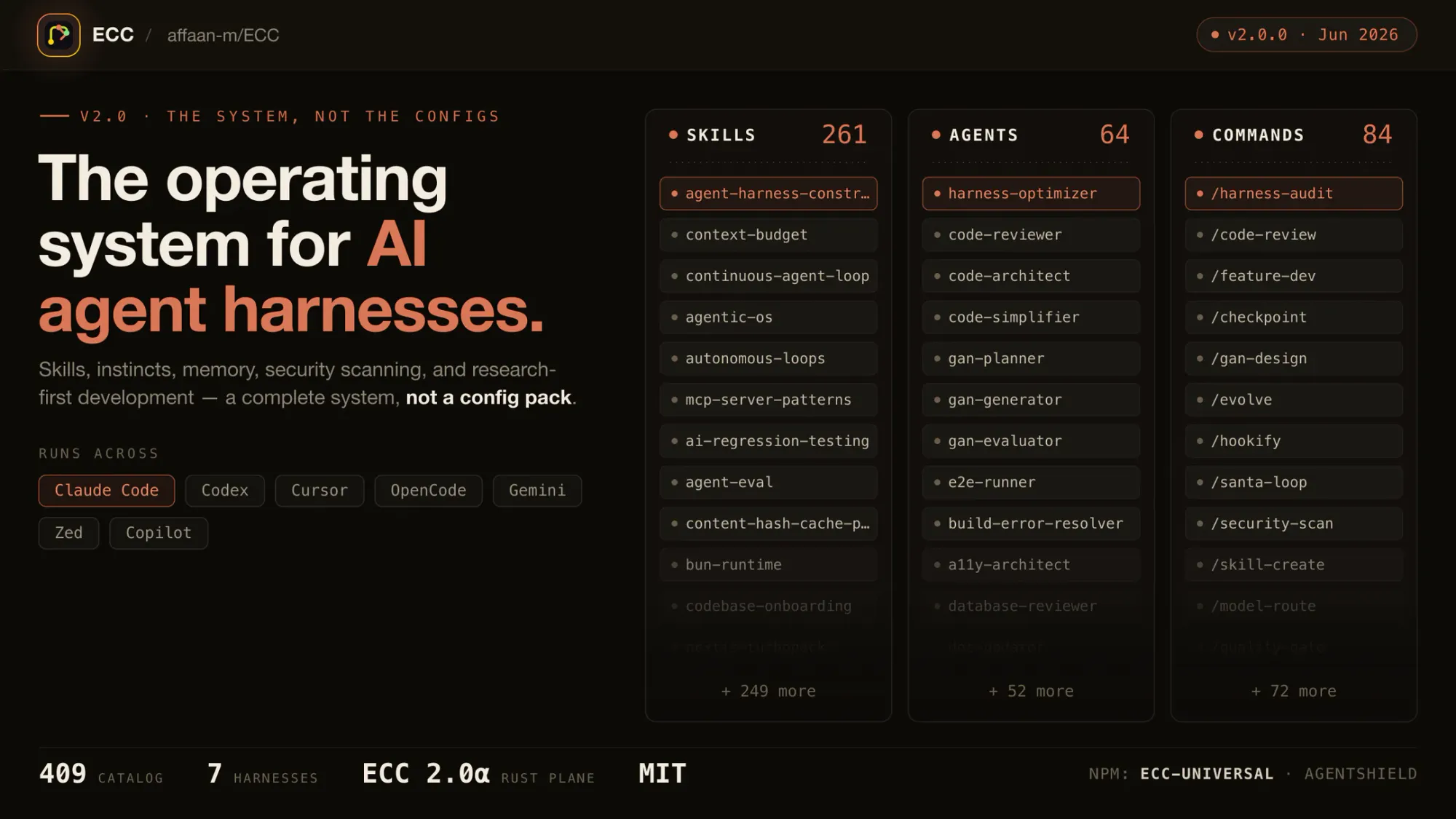
ECC is an MIT-licensed layer you install inside the coding agent you already run, so the agent plans before it types, tests the change, reviews its own diff from a clean context and records what it decided. For a studio shipping client sites with Claude Code, Codex or Cursor, it moves two billable things: how much rework the agent produces, and how much agent configuration your team has to keep alive.
The repository is affaan-m/ECC. The GitHub API on 18 November 2026 records 306,228 stars, 45,086 forks, JavaScript as the main language, an MIT license, creation on 18 January 2026 and a last push on 17 November 2026, with 164 open issues and pull requests counted together and 1,506 accounts watching releases. The project is ten months old. A push the day before you read this is not a support contract, and it means the catalog moves underneath anything you standardize on.
What the code lets you do and what it does not promise
The LICENSE file is the standard MIT text, copyright Affaan Mustafa, 2026. You can copy the skills, edit them, ship them inside a client repository and sell the work that comes out of them, as long as the copyright notice and the license text stay in copies of the software. The same file disclaims warranty and leaves the risk with you: no clause promises that a scan finds a problem or that a hook stops a bad deploy.
The license covers the repository, not the hosted product. The README says the open-source work stays free and that "ECC Pro is the hosted GitHub App for private repos". Nothing in the license gives you support, an SLA or a warranty. Read it before writing "we secure your agent setup" into a statement of work.
The problem in the room before you install anything
The project that hurts is not the first sprint. It is month three. The developer who set the agent up has moved to another engagement, and whoever picks up the branch has a chat transcript and nothing else. Nobody recorded why the checkout retries twice, or why staging needs one environment variable that production does not.
The invoice tells the same story. You billed eight hours, the agent produced code in forty minutes, and the rework landed in your evening: a migration nobody tested against, a form posting to the wrong origin, a dependency no test touches.
The handover is the sharp part, and it is where files in the repository beat anything kept in a vendor account. A client inheriting a repo with a working agent setup needs to know which config files matter and which of them a plugin wrote.
What ECC installs into the harness
GitHub's description calls the repository "The agent harness performance optimization system". The README read on 18 November 2026 offers 72 agents, 327 skills and 98 legacy command shims, plus hooks, rules, memory, continuous learning and the AgentShield scanner. The published package carries fewer: v2.2.0, released 28 August 2026, shipped 68 agents, 286 skills and 94 shims. Main runs ahead of npm because npm releases are cut per version tag rather than per commit.
The parts do different jobs. Skills load when a task needs them. Agents are workers with their own context and tool permissions. Rules are always loaded, so you install only the packs for the stack you use. Hooks run outside the model context on harness events. Instincts are patterns pulled out of past sessions with a confidence score.
Three names trip people who follow older tutorials: the repository is affaan-m/ECC, the Claude plugin is ecc@ecc, and the npm package is ecc-universal.
Install and first run
The guided path in the README needs Node.js 18 or newer, Git, and Claude Code 2.1 or newer on PATH, and then one command:
``bash npx ecc-universal@2.2.3 setup ``
The wizard inventories existing installs before it writes anything, then installs, updates or moves ecc@ecc into the scope you choose. Rerunning that command is how you update ECC or change its hook profile.
Claude plugins cannot distribute rules, so the README has you clone the repository and copy rules/common plus one language pack into ~/.claude/rules/ecc. Codex has a native marketplace path, and Cursor, Gemini, Zed and Qwen go through ./install.sh --profile minimal --target <harness>. The support commands matter more than the installer: node scripts/ecc.js doctor, repair, and an uninstall you can preview with --dry-run. Stacking two install methods in one harness duplicates skills, commands and hooks, and the README warns against it. I did not run ECC while writing this review, so this is the documented path rather than my install log.
Where it runs and what each harness gives up
The core CLI runs on Windows, macOS and Linux, though the README states that optional capabilities are not at parity: some continuous-learning and orchestration paths still need Bash or Python. Its platform table marks Windows native as "Supported with limitations" and names open defects in the continuous-learning observer daemon and in memory-vault writes, issues #2489 and #2626.
The harness table is the part to read before you standardize a team. Claude Code is the stable primary target. Codex has a native plugin whose hooks need an explicit trust decision instead of ECC's four hook profiles. Cursor is a beta project adapter where agent discovery varies by build. Copilot Chat is instruction-only, with instruction and prompt files and no ECC hooks. Gemini, Zed, Qwen, Hermes and Kimi are labelled experimental or minimal, and the project's own phrase for that group is that full Claude feature parity is not claimed. If much of your delivery happens inside Cursor, say so in the estimate.
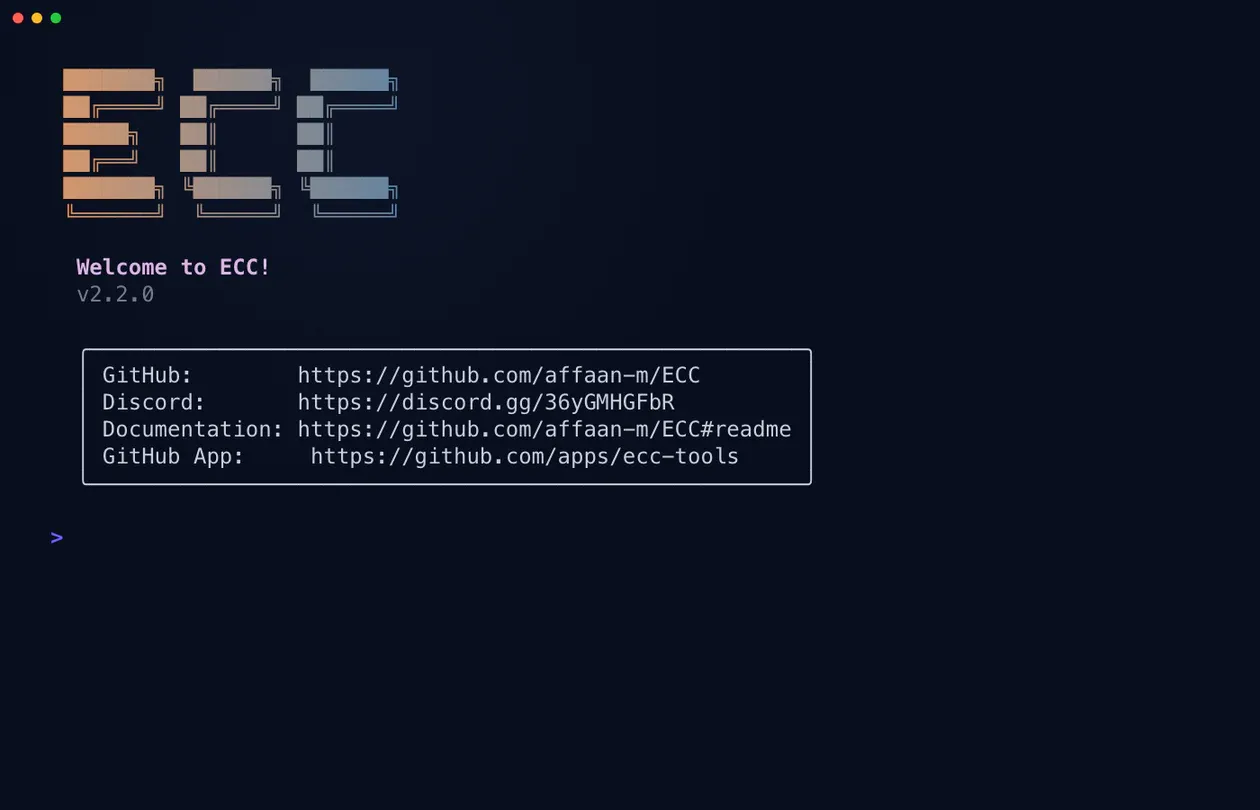
What survives a client handover
ECC's durable output is text. Instructions travel in AGENTS.md at the repository root, which the README calls the universal cross-tool file. Skills are SKILL.md files. The memory vault writes ecc.memory.v1 Markdown under .ecc/memory/ for project scope and ~/.ecc/memory/ for user scope, with a fail-closed .gitignore on project memories, and the README is blunt that memory is unreviewed context rather than policy.
Session data sits under one agent data root, ~/.claude by default, with session summaries, learned skills and cost metrics. Continuous learning keeps its instincts in ~/.local/share/ecc-homunculus, and session temp retention defaults to 30 days.
The pricing page answers storage in the words a client will use: the GitHub App analyzes commit history and file samples in memory, keeps no permanent copy of the code, and leaves one generated SKILL.md in the pull request. That is a vendor statement from ecc.tools, dated 18 November 2026, and it is the sentence for a data-processing note.
How ECC compares with Superpowers and the MCP reference servers
| ECC | Superpowers (obra/superpowers) | modelcontextprotocol/servers | |
|---|---|---|---|
| What it is | Skills, agents, hooks, rules, memory and security scanning installed into an existing harness (README, 18 Nov 2026) | "A complete software development methodology for your coding agents" built from composable skills (README, 18 Nov 2026) | Reference MCP server implementations, described in the README as educational examples rather than production-ready software (18 Nov 2026) |
| License and what it restricts | MIT per the LICENSE file and the GitHub API tag; the hosted GitHub App is a separate product | MIT per its README; commercial support by email to Prime Radiant, no price published on that page | GitHub reports NOASSERTION; the README states Apache-2.0 for new contributions with existing code under MIT, so the LICENSE file decides |
| Where it runs | In the harness, on Windows, macOS and Linux, plus an optional hosted GitHub App for private repos | In the harness plugin system; the README says install separately for each harness | A stdio subprocess the MCP client launches, or Streamable HTTP on 127.0.0.1:3001 |
| What it needs to run | Node.js 18 or newer; Git and Claude Code 2.1 or newer for guided Claude setup; some optional paths need Bash or Python | The harness itself; install commands are listed for Claude Code, Codex, Cursor, Gemini CLI and others. Its own runtime prerequisites are Not verified for this article | npx for the TypeScript servers, uvx or pip for the Python ones |
| What you maintain afterwards | Plugin version, hook profile choices, rule packs, the memory vault, and install state you check with doctor and repair | Skills updated through the harness; the README says updates are agent-dependent and often automatic | A pinned server package per project, plus the fact that many older reference servers moved to an archived repository |
| Community and support | Discord, GitHub Discussions; the pricing page gives Free community support, Pro priority email, Enterprise an SLA | Discord plus a commercial support address; pricing Not verified for this article | GitHub Discussions in the modelcontextprotocol organization |
| Stars, forks and last push | 306,228 stars, 45,086 forks, created 18 Jan 2026, pushed 17 Nov 2026 (GitHub API, 18 Nov 2026) | 319,815 stars, 28,529 forks, created 9 Oct 2025, pushed 3 Nov 2026 (GitHub API, 18 Nov 2026) | 92,088 stars, 11,978 forks, created 19 Nov 2024, pushed 18 Nov 2026 (GitHub API, 18 Nov 2026) |
| Best fit for a studio | Teams living in Claude Code that want enforcement, memory and security scanning and will own the upkeep | Teams that want one opinionated process with fewer moving parts across many harnesses | You need a connector such as git, a filesystem or a memory graph, not a workflow layer |
The cells that are still open
Three cells need a source you have to go and fetch. Superpowers publishes install commands for a dozen harnesses but no runtime prerequisites and no price: its README ends the commercial question with an email address to Prime Radiant, so it stays Not verified for this article. The MCP servers repository carries a license GitHub cannot tag and splits old code from new code across two licenses, so someone has to read the LICENSE file before you tell a client what they may ship. ECC's own adoption counts stay open on the vendor side, because the counters on ecc.tools are filled in by browser script and did not appear in the page I fetched, which is why the table uses the API record. Close those gaps by opening each LICENSE file and asking the vendor for a written quote rather than an emailed number.
What it costs in invoices and in context
Money first, from the pricing page read on 18 November 2026. The GitHub App has a Free tier at $0 covering public repositories, 10 analyses a month and 200 commits per run. Pro is $19 per active developer seat per month, or $190 a year, and adds private-repository analysis, 50 analyses per seat pooled on the installation, 1,000 commits per run, AgentShield-backed scanning and priority support. Enterprise is scoped by conversation: unlimited analyses, 5,000 commits per run, SSO and audit log surfaces, onboarding and an SLA. Prices move, so check that page again when you quote.
The cost that bites is context. The README warns that the Claude plugin "advertises the installed catalog to the model" and recommends a selective or manual profile when context footprint matters, which is the project's own way of saying that 327 skills have weight. The defaults are documented and tunable: SessionStart context is capped at 8,000 characters and can be switched off, six instincts at a confidence of 0.7 or higher are injected into a session, and hook strictness runs on the standard profile.
Labour recurs. Releases change catalog counts, install paths and hook behaviour, so an upgrade means reading notes, running doctor and repair, and re-testing the client's build with the hooks enabled. Put those hours in the retainer instead of finding them inside a sprint.
Where it breaks and what the project says about it
The project's troubleshooting file is specific, which is more useful to a support person than any product page. It documents context overflow when tool outputs pile up, hooks that never fire because they are not registered in settings.json, and slow responses traced to large observation files under ~/.claude/homunculus, with a compress-and-truncate routine as the fix. High CPU gets one switch: create a disabled file in that directory to pause continuous learning. The same file records a dev-server blocker that flagged legitimate commands containing the word dev, fixed in v1.8.0 through pull request #371, and a Windows line-ending problem that surfaces as "spawn UNKNOWN".
In OpenCode 2.x a v1-shaped plugin fails with a schema error, and a duplicated default export produces red "Duplicate plugin ID: ecc-hooks" entries. ECC_HOOK_PROFILE and ECC_DISABLED_HOOKS are read once at plugin setup, so a Windows setx does nothing until you open a new terminal.
The GitHub API on 18 November 2026 counts 164 open issues and pull requests on a repository with 45,086 forks, and that count alone tells you little. Two documentation details matter before you automate anything: the troubleshooting file asks for Claude Code 2.0 or newer while the README requires 2.1, and its dependency fix tells you to run npm install inside the plugin cache. Pin an exact version, run doctor after every update, and rehearse the uninstall before a client asks for it.
A recipe for one client project
1. Install from one channel and pin it. Run npx ecc-universal@2.2.3 setup for Claude Code or the Codex marketplace commands, then write the installed version into the project README. 2. Commit the instruction files with the code. AGENTS.md, rules/common and one language pack belong in the client repository rather than in one developer's home folder. 3. Turn on the hooks you can defend. Standard is the default profile, so list in the handover note what runs before a shell command and after an edit, and set ECC_DISABLED_HOOKS for anything the client's build cannot tolerate. 4. Scan the harness before the handover. Run the security scan skill or agentshield scan --path . and read the findings on permissions, secrets and MCP configuration yourself. 5. Write the handover as commands and paths: ecc doctor, ecc repair, uninstall with --dry-run, where the memory vault lives and in which scope, and one line saying its notes are unreviewed context the next developer has to verify.
Who should not use ECC
A client who needs contractual assurance should not get ECC on its own. The MIT license grants no warranty, the repository carries no SLA, and the tier that offers SSO, audit logs and a support commitment is a sales conversation at ecc.tools.
A Cursor-first or Copilot-first studio is adopting adapters that the project itself labels beta, experimental or instruction-only. If your delivery happens mostly inside Cursor, the fair comparison is against Cursor's own rules and hooks.
Windows-only teams should read issues #2489 and #2626 before anything else, because the continuous-learning observer and the memory vault both carry open native-Windows defects in the project's support table.
Anyone who will not read a changelog should stay out. The catalog stood at 67 agents and 281 skills in v2.1.0, moved to 68 and 286 in v2.2.0, and the README now lists 72 and 327 on main. Installing several hundred skills and never looking again puts an unreviewed prompt surface into a client repository.
Questions the reader asks first
Is ECC free to use on client work? Yes for the open-source part. The repository is MIT-licensed, and its LICENSE file lets you copy, modify and sell work built with it as long as you keep the notice. The paid layer is the hosted GitHub App at ecc.tools.
Do I have to install all 327 skills? No. The README recommends a selective or manual profile when context footprint matters, and rules only for the stack you use. rules/common plus one language pack is the documented minimum that still changes behaviour.
What happens if the maintainer stops? The files stay yours. Skills, agents and rules are Markdown inside your repository, and AGENTS.md is readable by other harnesses whether ECC runs or not. The README describes a single maintainer shipping weekly across seven harnesses, so price in the concentration: no SLA on the MIT side, and a fork is always available because the license allows it.
Does ECC behave the same in Cursor as in Claude Code? No. Claude Code is the stable primary target with the full hook profile, Cursor is a beta adapter where agent discovery varies by build, and Copilot Chat receives instructions only.
Where does my client's context end up? In local Markdown by default: .ecc/memory/ for project scope, ~/.ecc/memory/ for user scope, and session data under ~/.claude unless you move it with ECC_AGENT_DATA_HOME. On the hosted App, ecc.tools says code is analyzed in memory and never permanently stored.
Is AgentShield something I can promise a client? It is a scanner for agent configuration: prompts, hooks, MCP configuration, permissions, secrets and agent files. The pricing page puts that scanning in the Pro tier, and the vendor's own FAQ calls a scan a review aid rather than a guarantee of safety, so it belongs in your checklist, not your warranty.
Comments