Superpowers review: what a skills framework changes in delivery
Superpowers is a plugin plus 15 markdown skills that make a coding agent plan, test and review before it ships code. What that buys a two person studio, and where it leaks.
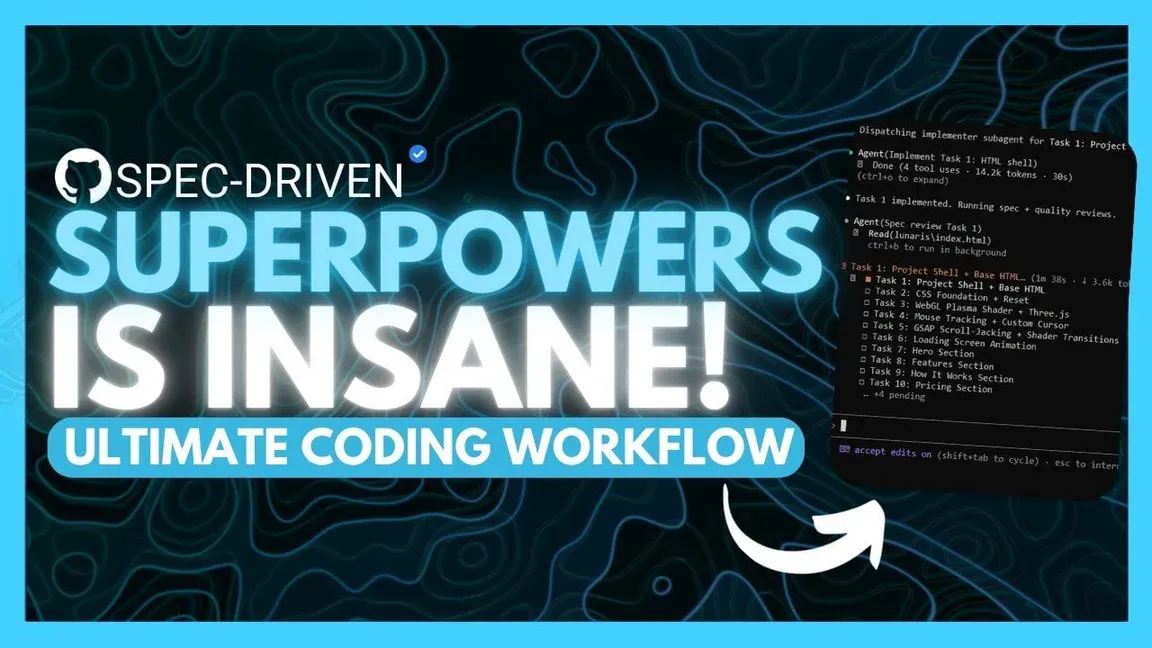
Superpowers is a plugin for a coding agent that installs a written process: 15 composable skills in markdown, plus a bootstrap instruction that tells the agent to check for a relevant skill before it starts a task. For a studio that ships client work, the effect is concrete. The design note, the task list, the failing test and the review report land in the repository as files, so the next developer reads them instead of phoning you.
The repository obra/superpowers has 319,815 stars and 28,529 forks, according to the GitHub API on 18 November 2026. GitHub created it on 9 October 2025 and tags the language as Shell. One small company sits behind it, Prime Radiant, where the author Jesse Vincent works, and the MIT license lets you take it to a client tomorrow.
What Superpowers is, and what it is not
The README calls it "a complete software development methodology for your coding agents", built on composable skills and on instructions that make the agent use them. A skill is a folder with a SKILL.md file: frontmatter with a name and a description, then the process in ordinary prose, sometimes with files in a references subfolder. The agent reads the description, decides whether the skill applies, loads the body.
What is not there matters. No server, no database, no account, and no model of its own: the tools your agent uses come from Claude Code, Codex, Cursor or whichever harness you run. What changes is the order of operations and the standard of evidence.
The license, the numbers, and what the push date means
The LICENSE file is MIT, "Copyright (c) 2025 Jesse Vincent". You may use, copy, modify, merge, publish, distribute, sublicense and sell copies, on one condition: keep the copyright and permission notices in every copy or substantial portion. There is no warranty. You can vendor the 15 skills into a client's private repository, edit them and never tell anyone, and nobody is on the hook when a skill misbehaves on a launch morning.
The GitHub API read on 18 November 2026 gives 1,167 subscribers, and the repository has no homepage set. It reports 359 open issues and pull requests combined, and the search endpoint puts open issues alone at 202. Discussions is off, so support happens in the Discord the README links and in the issue tracker.
The last-push date deserves a plain reading. Nothing was pushed between 3 November and 18 November 2026, when several other projects in this batch were. The fifteen day gap is not a stalled project: v7.0.0 came on 10 October, v7.0.1 on 21 October and v7.0.2 on 3 November, fixing bootstrap problems on six harnesses at once. The maintainer cuts releases, not continuous builds, so pin a version for client work.
The problem in the room: the agent that starts too early
A client asks for a booking form. You paste the request and the agent produces four hundred lines in one pass. There are no tests, nothing was written down, and you approve it because the screen looks right. Two weeks later the client says the confirmation also had to reach the office inbox, and neither of you can produce a record of what was agreed.
Superpowers targets that hole. It cannot improve the model and does not try to. It attacks the paperwork that turns a small change into a dispute: the decision, the plan, the proof that the thing works, the review. An agent that re-derives the architecture every session spends your token budget on work it already did. When a client's own developer takes the repository over, that gap becomes a call you have to take.
The workflow the skills impose, in order
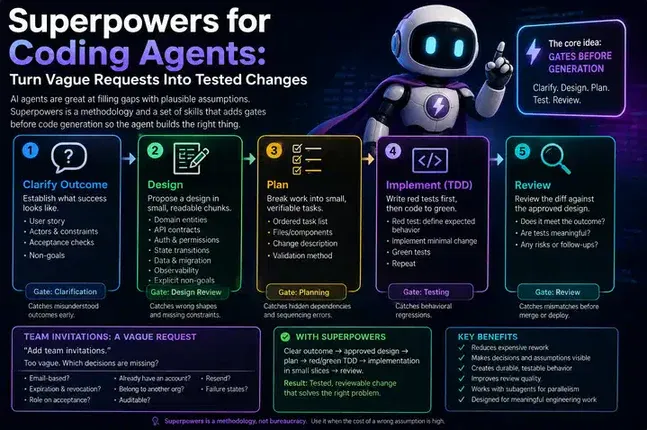
The README lists seven steps that fire automatically, calling them "mandatory workflows, not suggestions".
1. brainstorming runs before anything gets built. It asks what you want and why, plays its understanding back in short chunks, and writes a design document for anything larger than a small change. 2. using-git-worktrees creates an isolated branch once you approve the design and checks that tests pass on a clean baseline. 3. writing-plans breaks the work into tasks of two to five minutes each, with exact file paths, complete code and verification steps. 4. subagent-driven-development or executing-plans implements it: one fresh subagent per task with a review after each, or the plan inline with a single review at the end. 5. test-driven-development enforces RED-GREEN-REFACTOR and deletes code written before its test. 6. requesting-code-review reports issues by severity; critical ones block progress. 7. finishing-a-development-branch verifies tests, offers merge, pull request, keep or discard, and cleans up the worktree.
The README sets a low bar for a plan: clear enough for an enthusiastic junior engineer with poor taste and no project context to follow. It also claims an agent can work for a couple of hours without deviating from a plan, the maintainer's estimate rather than a benchmark.
Install, and what it needs on a real machine
The README documents sixteen install paths: Claude Code, Antigravity, the Codex app, the Codex CLI, Cursor, Devin CLI, Factory Droid, Gemini CLI, GitHub Copilot CLI, Grok Build CLI, Kimi Code, OpenCode, Pi, Qwen Code, Hermes Agent and Muse. Installation is per harness, so Claude Code on a laptop and Codex on a server means two installs. On Claude Code the shortest route is Anthropic's official marketplace with /plugin install superpowers@claude-plugins-official; Codex and Cursor have one-line versions.
Nothing needs hosting: the plugin is markdown plus a few shell and JavaScript files and hook scripts that run wherever the agent runs, on a laptop or a VPS with a terminal. No GPU is involved, since no model runs locally. On Windows the session-start hook goes through hooks/run-hook.cmd, which needs bash from Git for Windows; the v7.0.2 notes cover what happens when bash is missing or a WSL launcher gets picked instead. The optional visual companion in brainstorming starts a local Node script that serves screens to a browser and stops after thirty idle minutes; the repository states no minimum Node version.
Verify an install with the project's own acceptance check: send "Let's make a react todo list" in a fresh session and confirm that brainstorming starts before any code appears.
What survives a handover to the client
Account model: none to lose, no login, no tenant, no seat that expires and takes your configuration with it. Data location: the skills are files on your machine, and the artifacts they produce, design documents, plans and worktrees under .worktrees/, sit in the client's repository. Export path: copy the folder, not a ticket asking a vendor for a dump.
Two caveats sit on that row. Updates are, in the README's words, "somewhat coding-agent dependent, but are often automatic", which is convenient until a change lands between your quote and your delivery. v5.1.0 removed the legacy slash commands /brainstorm, /execute-plan and /write-plan and the named superpowers:code-reviewer agent, so a junior who learned those entry points loses them mid-project.
On telemetry the README is direct. The Prime Radiant logo in the optional visual companion loads from their website and carries the Superpowers version number, and nothing about your project, prompt or agent. SUPERPOWERS_DISABLE_TELEMETRY set to any true value switches it off, as do Claude Code's DISABLE_TELEMETRY and CLAUDE_CODE_DISABLE_NONESSENTIAL_TRAFFIC. Put that variable in the studio's machine setup, not a committed client file.
Contributing back is not a reliable path. The README says new skills are generally not accepted and that agent-written pull requests fixing someone else's issue are refused unless a maintainer asked; the v5.1.0 notes report a 94 percent rejection rate across the last hundred closed pull requests. Plan on a private fork.
Pin the version in the project README, and before the next engagement upgrade in a spare checkout, read the release notes and run one small change end to end: design note, plan, implementation, review, branch finish. Check that the design note, the plan file and a failing test committed before the code that fixes it are in the branch, and keep them in the client's repository rather than a scratch folder, the way docs/plans and docs/superpowers/specs hold dated design documents for the project's own changes. Write the handover note while the project is live: harness, version, skills that fired, and what the client's developer runs to reproduce a green baseline.
How it compares with ECC and the MCP reference servers
| Superpowers (obra/superpowers) | ECC (affaan-m/ECC) | MCP reference servers (modelcontextprotocol/servers) | |
|---|---|---|---|
| What it is | A development methodology plus 15 composable skills the agent loads by itself, per the README | An engineering toolkit: 72 agents, 327 skills, 98 command shims, hooks, rules, memory and AgentShield scanning, per the README | Seven reference MCP servers plus an archived set; the README calls them educational examples rather than production-ready software |
| License and what it restricts | MIT, copyright Jesse Vincent 2025. Copying, modifying and selling are allowed, the notice must stay, no warranty | MIT. The toolkit stays free; the paid layer is the hosted GitHub App on top of it | The README states Apache 2.0 for new contributions and MIT for existing code; the GitHub API tags the repository NOASSERTION, so GitHub did not recognize a single SPDX license |
| Where it runs | Inside the harness, no service of its own. Sixteen install paths in the README, one install per harness | Inside the harness, with Claude Code as the primary reference, native paths for Codex and Qoder, and capability-limited adapters for Cursor, OpenCode, Gemini, Zed, Copilot and others | A subprocess the client launches over stdio, or an HTTP service on 127.0.0.1:3001/mcp when you ask for the Streamable HTTP transport |
| What it needs to run | A supported harness and its plugin command. Bash on Windows via Git for Windows. Node for the optional companion; no minimum Node version is stated | Node.js 18 or newer, Git, and Claude Code 2.1 or newer for the guided setup, per the README | npx for the TypeScript servers, uvx or pip for the Python ones |
| What the reader maintains afterwards | One plugin install per harness, plus any skill text you forked. Updates are often automatic | Install scope and hook profiles, weekly releases, and a doctor and repair toolset that ECC ships for cleanup | Client configuration entries and version pinning, since the servers run from npx or uvx on demand |
| Community and support | Discord, GitHub issues and a release newsletter; enterprise contact is an email address. Discussions are not enabled (GitHub API, 18 November 2026) | Discord plus a GitHub App; priority support on Pro, priority plus an SLA on Enterprise (pricing page read 18 November 2026) | GitHub Discussions on the modelcontextprotocol organization; the servers are kept by the MCP steering group |
| Cost | MIT and free to copy. No price is published on primeradiant.com. Whether a paid Superpowers plan exists: Not verified for this article | Free on public repos at 10 analyses per month, Pro at $19 per seat per month or $190 per year, Enterprise by quote (pricing page read 18 November 2026) | Nothing to buy in the repository. Steering group response times on issues: Not verified for this article |
| Stars, forks, last push | 319,815 stars, 28,529 forks, pushed 3 November 2026 (GitHub API, 18 November 2026) | 306,228 stars, 45,086 forks, pushed 17 November 2026 (GitHub API, 18 November 2026) | 92,088 stars, 11,978 forks, pushed 18 November 2026 (GitHub API, 18 November 2026) |
| Best fit | A studio that wants the same agent to plan, test and review the same way on every project, with paperwork a client can read | A studio that wants breadth, hooks and scanning and is willing to maintain a much larger install | Giving an agent tools and data, not a method. You bring the process yourself |
Three cells stay open. Nobody publishes a price for Superpowers: the product page and site navigation I read on 18 November 2026 list no plans and no numbers, so whether a paid plan exists is Not verified for this article, and the README only points enterprise customers to sales@primeradiant.com for support, tooling and managed spending. ECC states a unit price but not your total: seats are sold per connected GitHub installation, so count your active developers first. For the reference servers, nothing I found on 18 November 2026 states how fast the steering group answers issues. Check the age of the open issues on any server you depend on.
Model time is the cost no price page lists, and the project documents where it goes. Notes for v5.0.6 say a subagent review loop doubled execution time, at about 25 minutes of overhead, with no gain in plan quality; an inline self-review replaced it, credited with three to five real bugs per run in roughly 30 seconds. The v7.0.2 notes quote a contributor who measured 83 percent of first-to-second-prompt transitions in Pi sessions rewriting the whole prompt cache, and the repository's eval harness runs scenarios of three to thirty minutes or more each. Two costs stay unpriced: your attention during brainstorming, and the harness bill on your provider's page.
Where it breaks, and what limits the damage
Context compaction is the sharpest problem. The v7.0.1 notes say Claude Code re-attaches each skill after a compaction, cut at 20,000 characters, and that in one session subagent-driven development lost its five-round fix limit and ran eighteen fix rounds on one task. The maintainers moved material into reference files and added a test that fails when a SKILL.md reaches 20,000 bytes. Mitigate with short sessions, cleared context between tasks, and an eye on the round counter.
The maintainers concede question fatigue. The v7.0.0 rebuild of brainstorming drew complaints recorded in issue #2530 and repeated in the v7.0.1 notes, that the questions "got annoying fast and felt formulaic". The v7.0.2 notes report filler questions down from 41 to 23 in blind-graded conversations, and an option list with a recommendation in 8 of 8 runs of one scenario.
The v7.0.2 notes list bootstrap failures repaired on six harnesses: Copilot on Windows rejected the session-start command with a PowerShell parse error, OpenCode models copied the namespaced skill name and got "skill not found", and on Debian and Ubuntu a shell mismatch stopped the bootstrap from loading. Run one throwaway session in the harness and OS your team uses first.
The tooling around plans fails loudly rather than safely. sdd-workspace used to write its workspace into whatever directory the agent was in, sometimes the plugin cache; the v7.0.2 fix makes the helpers act on the current repository or stop with an error, and a fresh project needs git init and a first commit. One report describes task-brief returning a 1,159-line brief for a 177-line task, because an unclosed code fence hid every later heading.
When a session misbehaves, the diagnosing-superpowers skill reads the transcript and reports what happened with line-level evidence. Keep the run in a branch you can delete.
Who should not use it
Skip it if your harness is not on the install list. Porting is a maintainer decision, and a pull request for a new harness needs a session transcript and an acceptance run, so a port you write is a fork you maintain.
Skip it if the client pays for speed and dislikes being asked questions. brainstorming spends its budget on the requirements conversation, and the maintainers changed that behavior three times in two months.
Skip it if you need support terms on paper before signing a client contract, or you want the widest toolbox rather than a method. Superpowers publishes no plan, no SLA and no price, only an email address. ECC ships 327 skills, 72 agents and AgentShield scanning, with paid support behind a $19 per seat plan.
Skip it if you will not read the plan. Every step assumes you approve a written design and a written task list, and without that approval you are still the person explaining the diff.
Questions studios ask before they install it
What does Superpowers actually do to my coding agent? It makes the agent look for a relevant skill before it acts, and those skills make it write a design note, a task plan, failing tests and a review report. The model stays the same; the sequence and the evidence rules change.
Is Superpowers free, or is there a plan I have to buy? The code and the skills are MIT licensed and free to copy, modify and ship inside a client repository. No price is published for Superpowers, and the README's commercial route is an email to the maintainers.
Will it work with the tools I already use? The README has install commands for sixteen harnesses, including Claude Code, both Codex surfaces, Cursor, Gemini CLI, Copilot CLI and Antigravity, and each needs its own install. Feature depth differs: hook support and compaction behavior vary, which is where most bug reports come from.
Can my client take over a project built with Superpowers? Yes, and there is no account to transfer. The skills are files, and the design documents, plans and worktrees are commits in the repository they already own.
Does it send information about my client work anywhere? One optional thing leaves your machine: the logo in the visual companion loads from the maintainers' site and carries the Superpowers version. Nothing about your project, prompt or agent goes with it, and SUPERPOWERS_DISABLE_TELEMETRY turns it off.
Does it make the agent's output good enough to ship without me? No. It produces a plan you must approve, a review that reports issues by severity, and tests that must pass before a branch finishes. The judgment stays yours.
Comments